
Home foundation types carry more than just the weight of your house. They carry decades of soil movement, weather cycles, shifting rainfall, and seismic activity. Choosing the right foundation isn’t about trends—it’s about long-term performance, structural integrity, and peace of mind.
Here’s a grounded look at the most common foundation systems, why they matter, and when a homeowner should act.
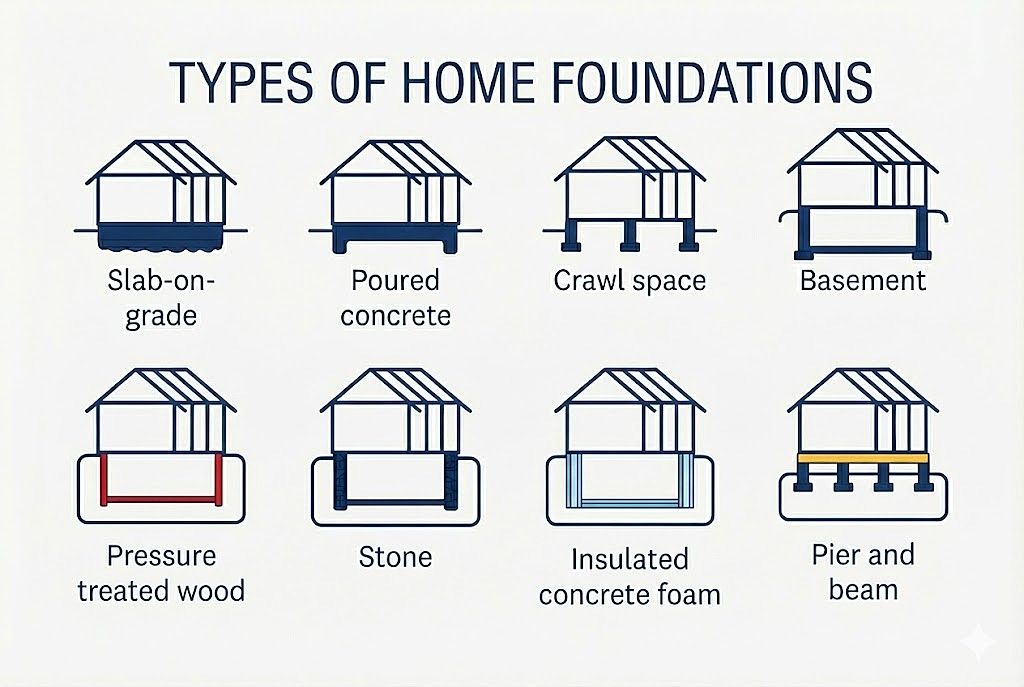
Concrete poured flat on level ground is the simplest slab-on-grade foundation approach for many residential builds.
Best match: Level lots in warm, arid regions where ground freezing isn’t a concern. Not recommended for sloped terrain or flood-prone areas.
A raised perimeter wall or pier system lifts your house off the ground as a crawl space foundation, leaving a small accessible void.
Best match: Areas with moderate moisture and flat-to-mild slopes. Ideal if repairs, retrofits, or HVAC upgrades may be needed in the future.
Basements create full or partial living space under a home and can be tailored to soil depth and slope.
Best match: Colder climates, hillside construction where daylight-basement design fits slope, or urban builds needing storage without expanding the footprint. Pair any design with attentive basement waterproofing to protect the investment.
Vertical piers drilled into stable earth support above-grade beams. Structured elevation mitigates slope or flood risks.
Best match: Coastal zones, river-bottom lots, hillside homes, or retrofit cases with uneven soil or historical houses. When slopes are significant, pairing piers with hillside foundation repair strategies keeps structures stable.
Expansive clay swells when wet and shrinks when dry, putting constant pressure on concrete. Loose fill can settle unevenly over time. In these cases, additional engineering like post-tension slabs, deeper footings, helical piers, or soil remediation measures help foundation systems stay level. Before any concrete is poured, a geotechnical survey should identify the soil’s bearing capacity and movement potential.
Seasonal rain, drought, coastal humidity, and seismic activity all influence foundation design. Site-specific concerns like standing water or erosion patterns drive waterproofing depth and drainage choices. If heavy rains are common, integrate a reliable drainage system alongside any slab, crawl space, or basement plan to keep moisture under predictable control.
A flat lot offers more flexibility in foundation choice. Sloped sites often benefit from raised solutions like pier-and-beam or engineered retaining structures that adapt to uneven terrain without excessive grading.
Future maintenance matters. Crawl space and pier-and-beam designs allow quick access to pipes, wiring, or HVAC components. Slabs conceal everything beneath concrete, making even minor repairs more invasive and potentially costlier.
A well-built basement adds usable square footage and resale appeal. Crawl spaces remain functional for decades with good sealing. Slabs are cost-effective upfront but can become liabilities on poor soil or after seismic events. Think 10, 20, even 50 years ahead to protect both structure and equity.
Structures often shift before anyone notices. Watch for these symptoms:
These warning signs may hide serious issues. Getting them checked early by a structural professional through a detailed foundation inspection can prevent more damage and keep future repairs more manageable.
Whatever the method, a licensed engineer should evaluate the site and soil beforehand. Foundation repair isn’t one-size-fits-all, and severe deterioration can call for full foundation replacement.
Foundation design reflects local terrain, weather patterns, and building history. Ignoring conditions beneath the surface invites failure later on. Not every crack means disaster—but every crack deserves context, expertise, and a structural answer.
If you’re seeing signs of movement, reach out to our Los Angeles foundation repair team before damage spreads. Alpha Structural offers licensed foundation repair services, planning, engineering, inspection, and construction—all in one firm to keep your home on solid ground with engineering-led solutions.